

Financial literacy and consumer education: the foundation of sustainable entrepreneurship

Financial literacy and consumer education help entrepreneurs manage resources, make informed decisions and build more sustainable businesses.
In this article, Laizia Santana examines the relationship between financial literacy and consumer education in the context of entrepreneurship, highlighting their role in decision-making, responsible resource management and the development of sustainable businesses.
In an increasingly demanding and competitive economic environment, entrepreneurship is no longer just about having a good idea. Today, business success depends largely on the ability to manage resources, make informed decisions and plan for the long term. In this context, financial literacy and consumer education play a central role, as they directly shape how entrepreneurs think, act and build resilient, sustainable businesses.
Financial literacy refers to the ability to interpret economic information, manage income and expenses, plan investments and deal with financial risk. Consumer education, meanwhile, is related to conscious decision-making, avoiding waste, impulsive spending and practices that can undermine a business’s financial health. When applied together, they become essential tools for building stronger and more sustainable companies.
Photo by The Yuri Arcurs Collection on Freepik
In addition, consumer education supports a more conscious use of resources, promoting the efficient use of available capital. In this way, entrepreneurs learn to distinguish between what is truly necessary and what can be postponed, reducing waste and improving profitability. As a result, these skills strengthen autonomy and increase the ability to adapt to market changes.

Photo by Karina Foto on Freepik
In addition, understanding financial indicators makes it possible to assess the viability of new projects and identify growth opportunities. Although some tasks, such as accounting, can be delegated, financial understanding remains essential for guiding strategy and avoiding excessive debt. Financial literacy therefore becomes a core pillar of business stability and longevity.

Photo by Aleksandar Little Wolf on Freepik
It also shapes relationships with customers and partners, encouraging more ethical and responsible practices. Businesses that embrace conscious consumption tend to value sustainability and social responsibility, factors that are increasingly recognised by the market. In this way, consumer education contributes not only to financial health, but also to brand credibility and reputation.
In addition, these skills encourage responsible innovation by promoting solutions that balance profit, social impact and respect for the environment. As a result, the business becomes more resilient and better prepared for the challenges of a constantly evolving market. Investing in the development of these abilities therefore means investing in business sustainability.

Photo by Freepik
In this context, the ability to understand and interpret information becomes essential for financial learning and informed decision-making. Investing in reading fluency tips can contribute to a better understanding of economic content, reports, contracts and training materials, reinforcing entrepreneurs’ autonomy and critical thinking.
Continuous training in these areas, in turn, helps build a more conscious and strategic entrepreneurial mindset. Over time, entrepreneurs make safer decisions, reduce mistakes and improve their chances of success. Financial and consumer education therefore become an important competitive advantage.

Photo by Frolopiaton Palm on Freepik
Among the main factors reinforcing their importance are:
The relationship between these skills and entrepreneurship can be seen clearly in the impact they have on management, decision-making and business sustainability.
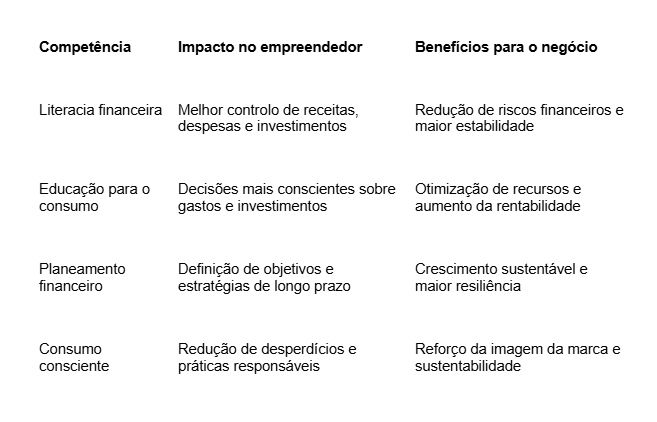
In the image: Table showing the relationship between financial literacy, consumer education and entrepreneurship 
Photo by Freepik
In an increasingly demanding and competitive economic environment, entrepreneurship is no longer just about having a good idea. Today, business success depends largely on the ability to manage resources, make informed decisions and plan for the long term. In this context, financial literacy and consumer education play a central role, as they directly shape how entrepreneurs think, act and build resilient, sustainable businesses.
What are financial literacy and consumer education in the context of entrepreneurship?
Financial literacy and consumer education are closely linked to entrepreneurship because they provide the knowledge and behaviours needed to manage a business in a balanced and responsible way. From the very beginning of an entrepreneurial journey, these skills help founders understand the value of money, control spending and make more informed decisions.
Why are these skills essential for entrepreneurs?
Entrepreneurship involves constant risks and strategic decisions. That is why financial literacy and consumer education help entrepreneurs act with greater confidence and responsibility. By mastering basic financial concepts, it becomes easier to analyse costs, forecast revenue and avoid common mistakes that lead many businesses to fail early.In addition, consumer education supports a more conscious use of resources, promoting the efficient use of available capital. In this way, entrepreneurs learn to distinguish between what is truly necessary and what can be postponed, reducing waste and improving profitability. As a result, these skills strengthen autonomy and increase the ability to adapt to market changes.
How does financial literacy impact business management?
Financial literacy has a direct and practical impact on business management. With this knowledge, entrepreneurs can organise cash flow, set appropriate prices and maintain control over company finances. This allows decisions to be based on concrete data rather than intuition alone.In addition, understanding financial indicators makes it possible to assess the viability of new projects and identify growth opportunities. Although some tasks, such as accounting, can be delegated, financial understanding remains essential for guiding strategy and avoiding excessive debt. Financial literacy therefore becomes a core pillar of business stability and longevity.
What role does consumer education play in business decisions?
Consumer education guides entrepreneurs towards making more conscious choices, both personally and professionally. In a business context, that means investing more carefully, negotiating better with suppliers and avoiding unnecessary expenses. As a result, available resources are used more efficiently.It also shapes relationships with customers and partners, encouraging more ethical and responsible practices. Businesses that embrace conscious consumption tend to value sustainability and social responsibility, factors that are increasingly recognised by the market. In this way, consumer education contributes not only to financial health, but also to brand credibility and reputation.
How do these skills promote sustainable entrepreneurship?
Sustainable entrepreneurship requires a long-term vision, planning and responsibility. In this sense, financial literacy and consumer education help build businesses that grow in a balanced way, without compromising future resources. By managing money well and consuming consciously, entrepreneurs create strong foundations to face crises and seize opportunities.In addition, these skills encourage responsible innovation by promoting solutions that balance profit, social impact and respect for the environment. As a result, the business becomes more resilient and better prepared for the challenges of a constantly evolving market. Investing in the development of these abilities therefore means investing in business sustainability.
Why should these skills be developed from an early stage?
The development of financial literacy and consumer education should begin as early as possible, both in personal and professional life. When these skills are acquired before launching a business, individuals enter the market better prepared to deal with financial challenges and complex decisions.In this context, the ability to understand and interpret information becomes essential for financial learning and informed decision-making. Investing in reading fluency tips can contribute to a better understanding of economic content, reports, contracts and training materials, reinforcing entrepreneurs’ autonomy and critical thinking.
Continuous training in these areas, in turn, helps build a more conscious and strategic entrepreneurial mindset. Over time, entrepreneurs make safer decisions, reduce mistakes and improve their chances of success. Financial and consumer education therefore become an important competitive advantage.
Why financial literacy and conscious consumption are central issues in today’s economy
Growing economic instability, the rising cost of living and the digitalisation of business have made financial literacy and consumer education essential skills for entrepreneurs in Portugal and around the world. Today, these areas play a strategic role in building businesses that are more prepared, resilient and sustainable.Among the main factors reinforcing their importance are:
- Rising indebtedness among households and small businesses, driven by inflation and higher interest rates;
- Easier access to credit and digital financial solutions, which requires knowledge to avoid risks;
- Growth in digital entrepreneurship and online businesses, which demand rigorous financial planning;
- Increased value placed on conscious consumption, sustainability and social responsibility by consumers and investors;
- The need for better informed financial decisions in a highly competitive global market.
The relationship between these skills and entrepreneurship can be seen clearly in the impact they have on management, decision-making and business sustainability.
Building with financial awareness means building sustainability
In summary, financial literacy and consumer education form the foundation of sustainable entrepreneurship, as they directly influence how businesses are planned, managed and developed. By combining financial knowledge with conscious consumption, entrepreneurs gain greater autonomy, reduce risk and build stronger, more responsible companies. In a market that is increasingly demanding and constantly changing, these skills are no longer optional — they are essential for anyone who wants to build with strategic vision, financial balance and a commitment to sustainability.


 Choose a job that you like, and you will never have to work a day in your life
Confucius
Chinese philosopher & Politician
Chinese philosopher & Politician